
Which Measuring Instruments Are Essential for Quality Control and Laboratory Research?
Introduction
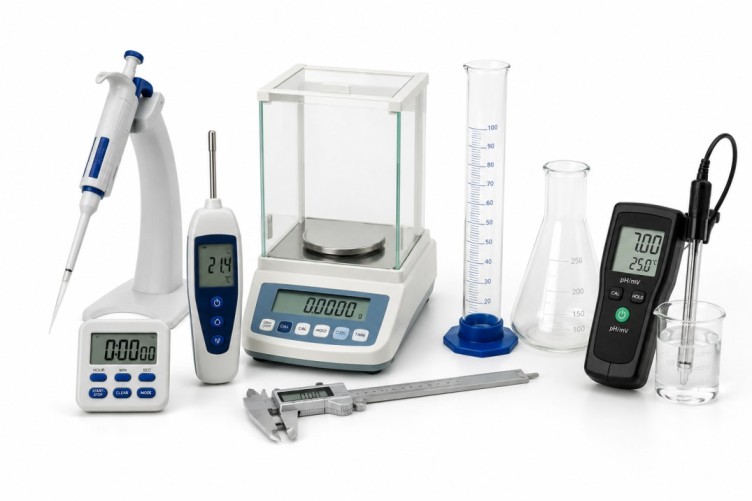
Products within the Measuring Instruments category help laboratories evaluate the physical, chemical, and environmental properties of samples. They support routine research, incoming-material inspection, process monitoring, product development, and final quality-control testing.
The instruments required by a laboratory depend on the materials being tested and the decisions based on the results. A pharmaceutical laboratory may prioritise precise mass, density, and oxygen measurements, while an environmental facility may require portable systems for testing water, temperature, humidity, and several parameters at once.
Why Are Reliable Measurements Important?
Quality control depends on objective evidence that a material or product meets defined requirements. Laboratory measurements can confirm concentration, composition, consistency, purity, stability, and environmental conditions.
Reliable instruments help laboratories:
- Compare raw materials
- Monitor production processes
- Confirm finished-product quality
- Detect unexpected variation
- Evaluate research samples
- Support method development
- Maintain traceable records
- Investigate failed results
An unsuitable or poorly maintained instrument may produce values that appear reasonable but do not represent the sample accurately. Equipment selection must therefore consider the full testing method rather than the displayed measurement range alone.
Why Are Balances Essential?
Balances are fundamental to almost every chemical, biological, pharmaceutical, and materials laboratory. They support reagent preparation, standard preparation, formulation, sample comparison, and quantitative analysis.
The correct balance should be selected according to:
- Maximum weighing capacity
- Readability
- Repeatability
- Minimum sample weight
- Pan dimensions
- Draft protection
- Calibration options
- Environmental conditions
A balance displaying more decimal places is not automatically suitable for every task. The instrument must provide acceptable performance at the actual sample weight being measured.
Vibration, airflow, static electricity, temperature changes, and an unstable bench can affect results. Balances should be installed on a firm surface and checked using suitable reference weights.
How Do Test Systems Support Routine Quality Control?
Test Systems can support rapid or method-specific analysis of chemical and environmental parameters. Depending on the system, testing may involve photometers, test kits, test papers, strips, or prepared reagents.
These systems are useful when laboratories need:
- Routine screening
- Fast process checks
- Field measurements
- Repeated water analysis
- Simple visual comparisons
- Standardised reagent quantities
- Portable testing options
Researchers should evaluate the method range, detection limit, possible interferences, sample preparation, and result interpretation. A quick test may be appropriate for screening, but confirmatory analysis may still be necessary when a result is close to a specification limit.
Reagents and test materials should be stored according to their instructions because heat, moisture, and expired components can alter performance.
When Is Density Measurement Required?
Density measurements help laboratories compare mass with volume. Density can provide information about concentration, composition, identity, purity, and batch consistency.
It is widely relevant to:
- Solvents
- Oils
- Chemical solutions
- Pharmaceutical liquids
- Food and beverage samples
- Coatings
- Fuels
- Formulations
Temperature must be controlled or recorded because liquid density changes as temperature changes. Results obtained at different temperatures may not be directly comparable.
The sample should also be free from unwanted bubbles, suspended contamination, or evaporation losses. Researchers should select an instrument or method appropriate for the expected density range, sample volume, viscosity, and required accuracy.
Why Should Humidity Be Monitored?
Products within Humidity support the measurement of moisture in air, materials, storage areas, and controlled environments.
Humidity can affect:
- Hygroscopic chemicals
- Powder flow
- Sample mass
- Biological materials
- Electronic equipment
- Packaging
- Incubator performance
- Long-term storage
High humidity may cause chemicals to absorb moisture, while very dry conditions can increase static electricity and make weighing difficult. Laboratories storing moisture-sensitive products should monitor both temperature and relative humidity.
The selected instrument should offer a suitable range, response time, accuracy, probe design, and data-recording capability. Continuous data logging may be more useful than occasional manual readings when environmental stability must be demonstrated.
How Do Oxygen Instruments Support Research?
Oxygen instruments can support dissolved-oxygen analysis, gas monitoring, biological studies, water testing, fermentation, and environmental research.
Oxygen measurements may be important for:
- Microbial cultivation
- Cell-based research
- Water-quality testing
- Bioreactor monitoring
- Wastewater analysis
- Food-processing studies
- Environmental investigations
- Chemical oxidation research
Researchers should determine whether oxygen must be measured in a liquid, gas, vessel, or surrounding environment. Sensor type, temperature compensation, response time, sample movement, and calibration method can all influence the result.
Dissolved-oxygen measurements may change when the sample is stirred, exposed to air, or allowed to warm. Testing conditions should therefore be standardised and documented.
When Are Multi-parameter Instruments Useful?
Multi-parameter instruments can combine several measurements within one portable or benchtop system. Depending on the configuration, a device may measure pH, conductivity, dissolved oxygen, temperature, salinity, or related parameters.
These systems are particularly useful when:
- Several parameters are tested together
- Bench space is limited
- Field measurements are required
- Samples must be analysed quickly
- Results need centralised storage
- Operators need one consistent interface
A combined instrument can simplify routine testing, but each connected sensor still requires suitable care and calibration. Laboratories should not assume that all parameters offer the same accuracy or range.
Before purchasing, users should review the available ports, sensor compatibility, expansion options, calibration functions, and data-management features.
What Features Should Be Compared?
Two instruments measuring the same property may differ considerably in practical performance.
Important selection criteria include:
- Accuracy and repeatability
- Working range
- Resolution
- Response time
- Sample-volume requirements
- Sensor compatibility
- Calibration process
- Data storage
- Export options
- Cleaning requirements
- Portability
- Available technical support
The required performance should be based on the method and acceptable uncertainty. Buying an instrument with unnecessary sensitivity can increase cost and maintenance without improving the final decision.
How Can Laboratories Maintain Measurement Quality?
Instrument reliability depends on regular checks and correct use. Calibration alone cannot compensate for poor sample preparation, damaged sensors, contaminated vessels, or inconsistent procedures.
Good measurement practice includes:
- Following written methods
- Training operators
- Checking instruments before use
- Using appropriate reference materials
- Recording calibration results
- Cleaning sensors correctly
- Monitoring environmental conditions
- Investigating unusual readings
- Scheduling preventive maintenance
- Keeping complete service records
Control samples can help laboratories detect gradual changes that may not be obvious during routine operation.
Conclusion
Essential measuring instruments support both quality control and laboratory research by providing dependable information about mass, composition, physical properties, and environmental conditions.
Balances support accurate preparation, test systems provide practical routine analysis, and density instruments help evaluate liquid composition. Humidity devices protect controlled environments, oxygen instruments support biological and environmental testing, while multi-parameter systems combine several measurements into one workflow.
The best instrument is one that matches the sample, method, required accuracy, workload, and laboratory environment. Careful selection, regular calibration, consistent operation, and documented maintenance help laboratories generate results that can be trusted.